 |
|
 |
Tools
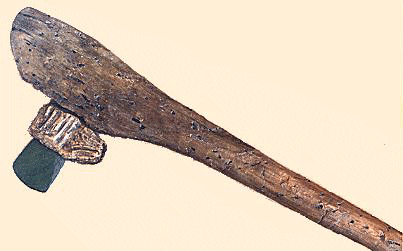
The tools are based on flint, which were either cut locally from flint found in the moraines or made from flint imported to make noble tools which were often used for a very long time, unlike the tools used for basic tasks, such as cutting wood or string ... The axe, the most vital tool of all, was the basic tool for clearing land and for building. It consisted of a handle, a blade and a sheath.
Traceological analyses provide information on the materials that were worked on using flint.
Axe
The axe is the most important tool to clearing and building the wooden houses
 |
A high degree of technical skill and a full knowledge
of nature are reflected in the production of pottery, woodwork (spoons,
weaving reeds,
pins,
wickerwork, baskets), textile
crafts (thread, mats, rugs, cloth and velvet), as well as cord
and string.
Garments were held closed by pins and women or
men embellished them with finery.
Some of the items produced, such as spoons or
weaving reeds, were used as trading currency for bartering with neighboring
or distant communities.
Apart from woodcutting scraps, which often bear
traces of tools, used for constructions, domestic
fittings and wooden utensils, the lacustrine mud has fully preserved axe
handles, mattocks and miscellaneous tools:
among other objects, five flint daggers (or knives)
still have vegetable fiber handle fittings in good condition, making them
items of exceptional interest.
The food
The inhabitants of Charavines knew how to take
advantage of the abundant forest resources to improve the produce of horticultural
type farming
(primitive soil
preparation, rudimentary
harvesting) by food gathering and the grazing
of domestic animals in the undergrowth.
Large game hunting (with deer accounting for 50
to 55 % their diet) was carried out in addition to the raising
of pigs, sheep and goats. There were very few cattle since the parcels of
land were only cleared for growing crops and not for producing hay. Fishing
was another food source.
In Charavines, the inhabitants had everything needed to
make fire (flint, pyrite and tinder), heat their homes and cook
food, in particular cereals.
The picking of fruit (apples, hazelnuts, sloe berries,
blackberries, etc.) supplemented the growing
of wheat (spelt and emmer), barley and poppies.
Even if flax was grown as a textile plant, a large
number of thicker vegetable fibers were provided by the leaves of reeds, nettle
stems and the lime bast of tree bark.
