 |
|
The two successive Charavines villages were incorporated in a network of relations which enabled exchanges between communities, often across long distances.
It is very difficult to specify the origin of
certain narrow-necked vases such as bottles, always made of fine ceramics:
a local "invention" or an idea from Italy?
In addition to these imported items, analyses of the ceramics have shown that
the vases made in Charavines were exported to both the Chalain lakeshore in
the Jura region and to the Bienne lakeshore in Switzerland, villages which
are part of the large complex of the "Civilisation Saône-Rhône " or "Néolithique
récent rhodanien",
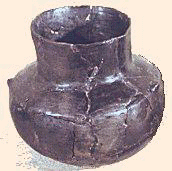 |
Certain objects found in the ground testify to
this: Baltic seashore amber, Touraine
flint (Grand-Pressigny), axe blades made
of green rocks from the Val d'Aoste or Piémont, a copper bead and a large
cylindrical vase with cordon from the Languedoc
region, a vase with rostrum handles and others decorated with dotted triangles
from the Atlantic coast of France, an axe-hammer
from western Switzerland, etc., confirming the group's cultural and technical
identity.
The first metal of the Alps appears in Charavines in the form of small beads
and short awls made of copper. An antimoneous
copper bead; this metal is known in the Languedoc area, origin which is
confirmed by the biconical shape, very usual in the Noon.
This metal should be very precious because reserved for the finery and for
the small tools intended to drill probably skins, delicate operation too with
the most sharpened flint.
Page 52 / 55
