 |
|
 |
The interest of the Charavines site is twofold.
First, there is an abundant harvest of vestiges and various objects abandoned
after the departure of the inhabitants, which make it possible to trace the
inhabitants' craft techniques and living conditions.
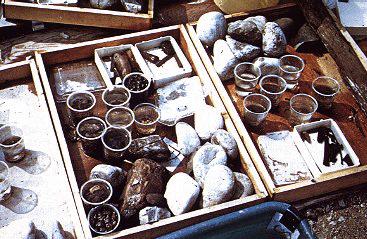
Located in the heart of dense forests, this archeological site has provided
multiple evidence of daily life, in particular in the form of perishable materials.
It has also made it possible to determine in considerable detail the farming
methods, vegetable and meat diet, and flint, wood and textile work. La conservation
des vestiges périssables.
 |
The houses
But perhaps even more important and spectacular is the revelation of the architecture
of the houses and lofts that made up the two successive villages. Complete,
systematic study, by dendrochronology, of all the
wood that has been found has enabled a precise reconstitution
of the inhabitants and their evolution (repairs, extensions, reconstruction,
etc.).
Although the study of the habitat
structures in Charavines was completed in 1990, it remains a model in
European archeology due to the precision and quality of the results.
A village of the Neolithic "Civilisation Saône-Rhône"
The cultural and technical data convey the privileged relations of the inhabitants
with those of lakes in the Jura and Savoie regions and western Switzerland
in the framework of the "Civilisation Saône-Rhône" (or "Néolithique
récent rhodanien"), as it has been individualized by the specialists.
