 |
|
 |
Absolute Dendrochronology
The principle of the dendrochronology is based on the comparison of the thickness
rings of growth: for a good reliability she should be applied in the biggest
possible number of trees.
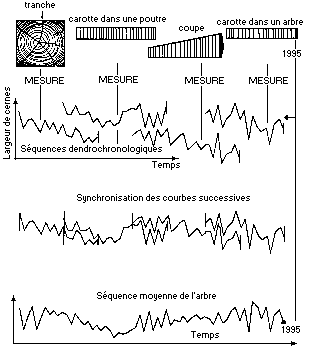
On the basis of thousand samples, it is then possible to build a reference
curve, "a standard" curve which characterizes the annual variations of humidity
and heat for one given geo-climatic sector and this during the longest possible
duration. In this standard curve is compared quite other curve established
on a trunk.
To study, to look for concordances, so chronological place: it is the absolute
dendrochronology. All these measures are treated by computer what accelerates
and refines the results and the specialists established today a scale of time
until seven millenniums B.C. with the oak tree.
Relative Dendrochronology
The principle is identical but here, the study
concerns only a lot of trunks from the same site; making the comparison between
them we know the time which separates the dates of cutting down.
It is what allowed in Charavines to establish the sequences of the villages
architecture.
