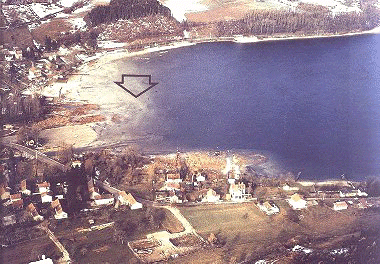
Location
of the submerged Neolithic village, south of the Paladru lake.
Underwater
excavations, carried out by the Centre de Documentation de la Préhistoire
Alpine (Alpine Prehistory Documentation Center) between 1972 and 1986 in Charavines,
on the Paladru lake between Lyons and Grenoble, have
revealed two small superimposed Neolithic villages, which have yielded exceptionally
well-preserved habitat structures and occupation layers. All the highly diversified
results obtained on this site are the result of the collaboration of numerous
scientific disciplines relating to the study of objects, fauna, flora and the
environment.
The archeological site is situated in the locality
of Les Baigneurs on the southern shore of the lake. It was discovered when the
water level of the lake dropped in 1904 and was rapidly explored in 1922 by
H. Müller. It was submerged when the waters rose
a short time after it was abandoned
These villages are an example of those built by the first farmers for several
millenniums in the French Northern Alps.
A large portion of the economy of temperate Europe of the Neolithic period was
based on forests, for buildings, tools, utensils and vessels as well as for
subsistence. However, only the sites later covered by water, on the shores of
lakes, such as Charavines, have preserved the extremely perishable plant vestiges
that make them so exceptionally interesting.