The
second village
After
the village had been abandoned for less than 40 years, the former inhabitants'
descendants went back and built another village in exactly the same location,
in 2612 B.C., for another and final period of occupation that lasted 20
to 22 years.
The installation process took place according to the same scheme as the
previous one, i.e. two houses, then five, two to three years later.
The trees that had colonized the neighboring land after the departure of
the first occupants were used to build houses, as well as many other trees
that the inhabitants had to go and fetch from dense forests much further
away.
Floor
made of intersecting bark plates
designed to avoid dampness in house 21,
during the second occupation period. The rounded figure (red arrow) is the bottom
of a vessel.
This
time, the village was abandoned more suddenly than the first one was, probably
due to a rapid, irreversible rise in the level of the lake: numerous vestiges
that were still usable were left behind. This was to be the last habitat on
the lakeshore site, but that does not mean that the surrounding region was deserted.
The pollens analyzed show several subsequent deforestation
operations, accompanied by cereals, testifying to the presence of human beings
in the surrounding region for another few centuries.
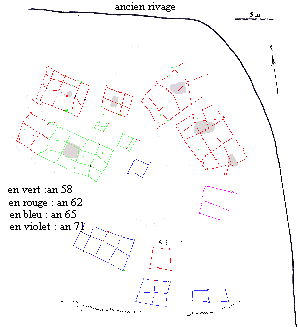
Plan
of the second village
showed by dendrochronology
Plan
of the second village with houses
built in the years 58, 62, 65 and 71 (2611,
2607, 2604 et 2598 BC).
Page
20 / 55